
You finish a hard workout feeling accomplished, only to wake up the next morning feeling like you’ve been hit by a truck.
Your muscles are sore, your energy is low, and even climbing a flight of stairs suddenly feels like a workout of its own.
Some soreness after challenging exercise is normal. But when slow muscle recovery becomes a recurring problem, it can interfere with your entire training routine.
You may find yourself:
- Waiting longer between workouts
- Reducing the weight you normally lift
- Struggling to complete your next training session
- Feeling tired throughout the day
- Losing motivation
- Making less progress toward your fitness goals
Recovery is just as important as training. Your workouts provide the stimulus, but your body needs adequate nutrition, rest, and sleep to repair and adapt.

This is where Deca-Max may fit into the picture.
Deca-Max is a CrazyBulk supplement marketed toward muscle growth, strength, workout performance, and recovery. Its formulation includes ingredients such as L-arginine alpha-ketoglutarate, L-citrulline, acetyl-L-carnitine, Panax ginseng, wild yam, and Tribulus terrestris.
But what does that actually mean for someone experiencing slow muscle recovery?
In this guide, we’ll explore why recovery can take longer than expected, what Deca-Max is designed to do, how its ingredients may fit into a recovery-focused routine, and the lifestyle factors that matter most for getting back to training effectively.
Table of Contents
What Is Slow Muscle Recovery?
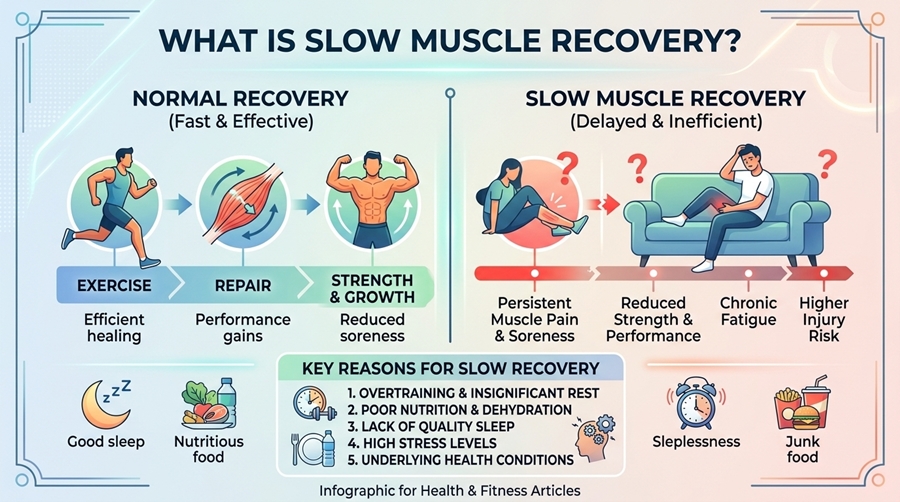
Muscle recovery refers to the process your body goes through after exercise to repair the stress caused by training and adapt to future demands.
Resistance training creates microscopic damage and metabolic stress within muscle tissue. Your body then works to repair and remodel that tissue.
Some soreness and fatigue are therefore completely normal.
The problem occurs when recovery consistently takes longer than expected or begins interfering with your training.
Signs you may be experiencing slow muscle recovery include:
- Muscle soreness lasting several days
- Persistent muscle fatigue
- Reduced strength during subsequent workouts
- Decreased exercise performance
- Feeling unusually exhausted after training
- Difficulty maintaining your normal training schedule
- Poor motivation to exercise
- Feeling like your muscles never fully recover
The cause isn’t always a supplement deficiency.
Often, recovery problems are related to training volume, nutrition, hydration, or sleep.
Why Does Muscle Recovery Take So Long?
Several factors can contribute to slow recovery.
1. You’re Training Too Hard
More training isn’t automatically better.
If you continually push your body with high training volume and insufficient recovery, fatigue can accumulate.
This is sometimes referred to as functional overreaching when strategically used, but excessive training without adequate recovery can negatively affect performance.
Signs you may need to reduce your training load include:
- Persistent soreness
- Declining strength
- Poor sleep
- Constant fatigue
- Reduced motivation
- Increased irritability
- Performance plateaus
2. You’re Not Eating Enough Protein
Protein supplies amino acids required for tissue repair and muscle protein synthesis.
If your protein intake is consistently inadequate, your body may have fewer nutritional resources available for recovery.
Good protein sources include:
- Eggs
- Chicken
- Turkey
- Beef
- Fish
- Greek yogurt
- Cottage cheese
- Milk
- Whey protein
- Soy
- Beans
- Lentils
3. You’re Not Eating Enough Calories
This is particularly important for people who are training frequently.
Your body needs energy not only to fuel workouts but also to support recovery afterward.
If you’re consistently under-eating, recovery may become more difficult.
4. You’re Dehydrated
Water plays a role in numerous physiological processes, including nutrient transport and maintaining normal muscle function.
Even relatively mild dehydration can make exercise feel more difficult.
Make hydration a priority before, during, and after training.
5. You’re Not Sleeping Enough
Sleep is one of the most overlooked components of recovery.
If you’re regularly getting only five or six hours of sleep, your body may not be recovering as effectively as it could.
Rather than immediately looking for another supplement, examine your sleep schedule first.
6. You’re Not Taking Rest Days
Muscles don’t need to be trained every day to grow.
Strategic rest allows accumulated fatigue to dissipate and gives your body time to recover.
What Is Deca-Max?
Deca-Max is a CrazyBulk dietary supplement marketed toward men who want support for:
- Muscle growth
- Strength
- Workout performance
- Stamina
- Recovery
It is promoted as a natural alternative to Deca-Durabolin, but it is important to make a clear distinction: Deca-Max is a dietary supplement and is not pharmaceutical nandrolone or an equivalent to anabolic steroid therapy.
Its current formula contains several botanical and amino-acid-based ingredients intended to complement a resistance-training routine.
For someone experiencing slow muscle recovery, the primary reason to consider Deca-Max would be its marketed recovery and workout-performance support.
Deca-Max Ingredients and Their Intended Roles

Understanding the ingredients provides more context than simply looking at the product’s marketing claims.
L-Arginine Alpha-Ketoglutarate
L-arginine is an amino acid involved in nitric oxide metabolism.
Nitric oxide contributes to blood-vessel dilation and blood flow.
Deca-Max combines L-arginine with alpha-ketoglutarate.
From a workout perspective, arginine-based ingredients are commonly used in sports nutrition formulas intended to support exercise performance and blood flow.
However, evidence for oral arginine supplementation is mixed, and it shouldn’t be assumed that taking it will automatically accelerate muscle recovery.
L-Citrulline
L-citrulline is another amino acid associated with nitric oxide production.
The body can convert citrulline into arginine, which subsequently participates in nitric oxide metabolism.
Citrulline supplementation has been studied in sports nutrition, particularly for exercise performance and perceived muscle fatigue.
This makes it a logical ingredient in a pre-workout-oriented formula, although individual responses can vary.
Acetyl-L-Carnitine
Acetyl-L-carnitine is a form of carnitine involved in cellular energy metabolism.
Carnitine plays a role in transporting fatty acids into mitochondria, where they can be used in energy production.
Deca-Max includes acetyl-L-carnitine as part of its performance-focused formulation.
Panax Ginseng
Panax ginseng is a botanical ingredient that has been traditionally used for energy and vitality.
It has also been studied for potential effects on fatigue and physical performance.
In Deca-Max, ginseng contributes to the formula’s broader focus on workout performance and stamina.
Wild Yam
Wild yam is a botanical ingredient included in Deca-Max.
It has a long history of use in traditional herbal preparations.
Its inclusion contributes to the botanical component of the formula, although claims surrounding wild yam and muscle recovery should be treated cautiously because evidence for meaningful muscle-building effects in humans is limited.
Tribulus Terrestris
Tribulus terrestris is a botanical commonly found in sports and men’s health supplements.
It is often marketed for testosterone and strength support.
However, human research has not consistently demonstrated meaningful increases in testosterone or muscle growth from tribulus supplementation.
Therefore, it is better viewed as one component of the overall formula rather than a guaranteed muscle-building ingredient.
How Deca-Max May Support Recovery
So, how does this relate to slow muscle recovery?
Deca-Max is marketed as a supplement that supports several areas surrounding training and recovery rather than directly “repairing” damaged muscle.
1. Supports Workout Performance
Ingredients such as L-citrulline and L-arginine are commonly included in sports supplements designed to support exercise performance and blood flow.
Better workout performance can potentially help you maintain training quality over time.
However, a supplement shouldn’t be used to push through excessive fatigue.
2. Supports Stamina
Panax ginseng and acetyl-L-carnitine contribute to the formula’s focus on energy and physical performance.
For someone who feels unusually fatigued after workouts, supporting overall training capacity may help make a consistent exercise routine easier to maintain.
3. Supports the Recovery Phase
CrazyBulk markets Deca-Max toward recovery following exercise.
It’s important to understand what this means in practical terms.
Recovery isn’t a single biological process that one supplement can switch on. It involves:
- Muscle protein synthesis
- Replenishment of glycogen
- Fluid balance
- Nervous-system recovery
- Reduction of exercise-induced fatigue
- Adequate sleep
- Tissue repair
Deca-Max is intended to complement this broader process rather than replace it.
Deca-Max Before or After a Workout?
CrazyBulk’s current directions recommend taking Deca-Max before workouts on training days.
This is worth noting because Deca-Max is often discussed in the context of recovery, but its suggested timing is primarily pre-workout.
The logic is to have its performance-oriented ingredients available around your training session.
Always follow the current product label and manufacturer’s directions rather than assuming that taking more will produce better results.
Deca-Max and Muscle Growth
Although this article focuses on slow muscle recovery, recovery and muscle growth are closely connected.
Your muscles need adequate recovery to adapt to resistance training.
A typical muscle-building cycle looks roughly like this:
Training → Fatigue → Recovery → Adaptation → Increased Training Capacity
If you repeatedly train before you’ve adequately recovered, your performance can suffer.
That’s why recovery shouldn’t be treated as time away from your goals.
It’s part of the process of reaching them.
How to Improve Slow Muscle Recovery Naturally
Deca-Max may be one component of a recovery-focused strategy, but lifestyle fundamentals are far more important.
Prioritize Protein
Aim to include a quality protein source in each major meal.
For people who resistance train regularly, total daily protein intake matters more than obsessing over one specific post-workout window.
Eat Enough Carbohydrates
Carbohydrates help replenish muscle glycogen, which is an important fuel source during resistance training and other high-intensity exercise.
Useful sources include:
- Rice
- Potatoes
- Oats
- Pasta
- Bread
- Fruit
- Quinoa
Stay Hydrated
Don’t wait until you’re extremely thirsty to drink water.
Your hydration needs increase when you’re exercising heavily or training in hot and humid environments.
Sleep 7–9 Hours When Possible
Individual sleep needs vary, but most adults benefit from getting sufficient sleep every night.
A consistent sleep schedule can be just as important as the number of hours.
Schedule Rest Days
If you’re training six or seven days a week and constantly feel exhausted, adding recovery days may be more useful than adding another supplement.
Active Recovery for Better Muscle Recovery
Rest doesn’t always mean lying on the couch all day.
Light activity can be a useful part of recovery.
Examples include:
- Walking
- Easy cycling
- Gentle mobility work
- Light stretching
- Low-intensity swimming
The goal is to move without creating additional significant training stress.
Don’t Confuse Soreness With Progress
One common misconception is that extreme soreness means you had a better workout.
It doesn’t.
Delayed-onset muscle soreness (DOMS) can occur after unfamiliar or particularly demanding exercise, but being extremely sore isn’t a requirement for muscle growth.
A productive workout should ultimately be judged by factors such as:
- Progressive overload
- Exercise technique
- Training volume
- Consistency
- Strength progression
- Recovery
Not simply how painful the next morning feels.
How to Tell If Your Recovery Is Improving
Track your performance rather than relying exclusively on soreness.
Strength
Are you able to maintain or increase your normal weights?
Repetitions
Can you perform your planned repetitions without a dramatic performance decline?
Energy
Do you feel ready for your next workout?
Soreness
Does soreness resolve within a reasonable period rather than continuously accumulating?
Sleep
Are you sleeping consistently and waking up feeling reasonably refreshed?
A combination of these indicators provides a better picture than soreness alone.
Who May Consider Deca-Max?
Deca-Max may appeal to adult men who:
- Train regularly with weights
- Want to support workout performance
- Are interested in recovery support
- Want to maintain training consistency
- Are pursuing muscle growth and strength goals
- Already have a solid nutrition and recovery routine
However, it should not be viewed as a treatment for chronic fatigue, persistent pain, or an underlying medical condition.
When Slow Muscle Recovery Could Indicate a Problem
Occasional soreness is normal.
Persistent or worsening symptoms deserve more attention.
Consider speaking with a healthcare professional if you experience:
- Severe or persistent muscle pain
- Significant weakness
- Swelling
- Dark-colored urine after intense exercise
- Recurrent injuries
- Extreme fatigue
- A substantial decline in exercise performance
- Symptoms that don’t improve with adequate rest
Particularly severe muscle pain, weakness, or dark urine following strenuous exercise can require urgent medical evaluation.
Common Mistakes That Slow Recovery
Training the Same Muscle Group Too Frequently
Muscles need time to recover between demanding sessions.
Increasing Weight Too Quickly
Progressive overload should be gradual.
Trying to add substantial weight every workout can increase fatigue and compromise technique.
Cutting Calories Too Aggressively
If you’re simultaneously trying to lose fat and maintain intense training, an excessively large calorie deficit can make recovery harder.
Ignoring Carbohydrates
Very low carbohydrate intake can make high-intensity training more difficult for some people.
Treating Sleep as Optional
You can’t out-supplement consistently poor sleep.
Using Supplements to Mask Fatigue
Feeling tired doesn’t always mean you need a stronger pre-workout.
Sometimes your body is simply telling you that you need rest.
Deca-Max vs. Other Recovery Strategies
Rather than thinking about Deca-Max in isolation, consider where it fits within the bigger picture.
| Recovery Strategy | Primary Purpose |
|---|---|
| Adequate protein | Provides amino acids for muscle repair |
| Sufficient calories | Provides energy for recovery and adaptation |
| Carbohydrates | Supports training fuel and glycogen replenishment |
| Hydration | Supports normal physiological and muscle function |
| Sleep | Supports overall physical recovery |
| Rest days | Helps manage accumulated training fatigue |
| Active recovery | Maintains light movement without significant stress |
| Deca-Max | Supplemental support for performance and recovery |
This makes the appropriate role of Deca-Max clearer.
It belongs near the bottom of the pyramid, after the fundamentals have been addressed.
Deca-Max Real User Feedback & Testimonials
Customer feedback can provide useful context when evaluating how Deca-Max fits into a workout and recovery routine. CrazyBulk’s current Deca-Max product page lists 51 customer reviews, with 76% rated five stars.
The following testimonials come from named Deca-Max customers and focus on the improvements they reported, particularly around muscle recovery, strength, muscle gain, and workout performance.
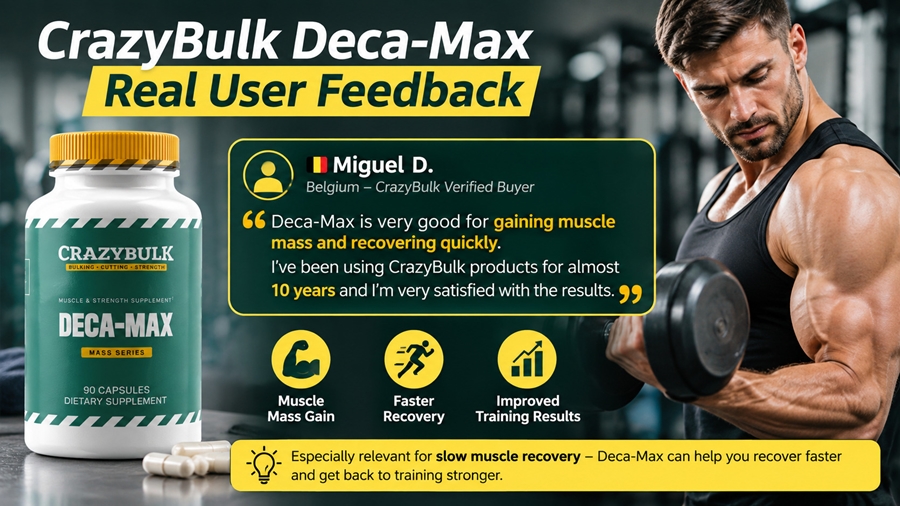
1. Miguel D. – Faster Recovery and Muscle Gain
Miguel D. from Belgium reported two improvements that are especially relevant to this article: muscle gain and faster recovery.
In his review, Miguel described Deca-Max as very good for gaining muscle mass and recovering quickly. He also said he had been using CrazyBulk products for almost 10 years and was very satisfied with his results.
For someone dealing with slow muscle recovery, Miguel’s feedback is particularly relevant because recovery speed was one of the specific improvements he highlighted.
2. Marcus – Bigger Pumps and More Repetitions
Marcus from the United States reported that Deca-Max helped him achieve bigger muscle pumps and perform considerably more repetitions.
He noted that it took a few weeks before he noticed or felt the effects, but he subsequently experienced improvements in his training performance.
This type of feedback is relevant to recovery because being able to maintain training performance can help support consistency throughout a longer muscle-building program.
3. Pascal M. – Improved Strength and Recovery
Pascal M. from France specifically reported that Deca-Max was excellent for strength and recovery.
His feedback directly corresponds to two of the primary goals of a recovery-focused supplement: maintaining strength during training and supporting the recovery process between workouts.
4. Apostolos K. – Muscle Mass, Strength, Endurance, and Recovery
Apostolos K. from Canada reported significant improvements in muscle mass, strength, endurance, and recovery after using Deca-Max.
He also said he would recommend the product and intended to order another cycle.
His testimonial is particularly relevant because it covers several areas that can influence a person’s ability to maintain a consistent training routine—not just recovery, but also strength, endurance, and muscle development.
5. James K. – Increased Exercise Weights
James K. from the United States reported using Deca-Max alongside creatine and electrolytes and described noticeable increases in the weights he could use during his exercises.
For example, he reported increasing his triceps-extension weight from 50 lb to 70 lb. He also noted that his shirts were becoming tighter around his muscles rather than his waist.
Because James used Deca-Max together with other products, his results cannot be attributed to Deca-Max alone. Nevertheless, his experience provides an example of the type of strength and physical-development improvement a customer associated with a Deca-Max-containing routine.
Deca-Max Customer Feedback at a Glance
| Customer | Reported Improvement |
|---|---|
| Miguel D. | Muscle gain and faster recovery |
| Marcus | Bigger pumps and more repetitions |
| Pascal M. | Improved strength and recovery |
| Apostolos K. | Muscle mass, strength, endurance, and recovery |
| James K. | Increased exercise weights and noticeable physical development |
What Can We Learn From These Testimonials?
The named customer experiences show several recurring themes around Deca-Max, particularly:
- Faster recovery
- Improved strength
- Greater workout endurance
- Increased repetitions
- Muscle development
- Better workout performance
However, these are individual customer testimonials rather than clinical evidence. Some customers also used Deca-Max alongside other supplements, making it impossible to determine how much of their reported progress came from Deca-Max alone.
Therefore, if you’re experiencing slow muscle recovery, these testimonials can be viewed as encouraging user experiences rather than a guarantee of results.
The fundamentals still matter most: adequate protein and calories, hydration, sufficient sleep, appropriate training volume, rest days, and a progressive resistance-training program. Deca-Max should be considered a potential supplement to those habits—not a replacement for them.
FAQs – Deca-Max for Slow Muscle Recovery
What causes slow muscle recovery?
Slow muscle recovery can be caused by excessive training, insufficient sleep, inadequate protein or calories, dehydration, stress, or insufficient rest between workouts.
Can Deca-Max help with slow muscle recovery?
Deca-Max is marketed by CrazyBulk as supporting workout performance, stamina, muscle growth, and recovery. However, individual results can vary, and it should complement—not replace—adequate nutrition and rest.
When should I take Deca-Max?
CrazyBulk currently recommends taking Deca-Max before workouts on training days. Follow the current product label for the most up-to-date directions.
Does Deca-Max directly repair muscles?
No supplement should be considered a direct replacement for the body’s natural recovery processes. Deca-Max is marketed as providing nutritional support around workout performance and recovery.
How long should muscle soreness last?
Soreness varies depending on the workout and your training experience. If severe soreness persists unusually long or is accompanied by significant weakness or other concerning symptoms, seek medical advice.
Does protein speed up muscle recovery?
Adequate protein provides amino acids needed for muscle protein synthesis and repair. Total daily protein intake is generally more important than relying on a single post-workout serving.
Can lack of sleep cause slow muscle recovery?
Yes. Insufficient sleep can negatively affect recovery, energy, exercise performance, and overall well-being.
Can dehydration affect muscle recovery?
Dehydration can impair normal physical performance and contribute to fatigue. Maintaining adequate fluid intake is therefore an important part of recovery.
Should I work out when my muscles are still sore?
It depends on the severity and location of the soreness. Light soreness may not prevent training, but significant pain or weakness may indicate that additional recovery is appropriate.
Is muscle soreness necessary for muscle growth?
No. You don’t need to be extremely sore after every workout to build muscle. Consistent progressive resistance training is more important.
Can overtraining cause slow muscle recovery?
Excessive training without sufficient recovery can contribute to persistent fatigue, reduced performance, and prolonged soreness.
Does Deca-Max contain steroids?
Deca-Max is marketed as a dietary supplement and is not pharmaceutical nandrolone or Deca-Durabolin. It should not be considered equivalent to anabolic steroid medication.
What ingredients are in Deca-Max?
The current Deca-Max formula includes ingredients such as L-arginine alpha-ketoglutarate, L-citrulline, acetyl-L-carnitine, Panax ginseng, wild yam, and Tribulus terrestris.
Can I use Deca-Max every day?
Follow the manufacturer’s current usage instructions rather than assuming daily use is appropriate. CrazyBulk’s current directions specify different usage around training and rest days.
When should I see a doctor about muscle recovery?
Seek professional medical advice if you have persistent or severe muscle pain, significant weakness, recurrent injuries, extreme fatigue, dark urine following intense exercise, or symptoms that don’t improve with rest.
Final Verdict
Slow muscle recovery can undermine even the best training program.
When you’re still sore and fatigued by the time your next workout arrives, it becomes harder to maintain intensity, increase your weights, and make consistent progress.
Deca-Max may provide supplemental support as part of a broader recovery strategy. Its formulation combines ingredients marketed toward workout performance, stamina, strength, and recovery, including L-citrulline, L-arginine alpha-ketoglutarate, acetyl-L-carnitine, and Panax ginseng.
But it’s important to keep expectations realistic.
The foundation of effective recovery remains adequate protein, sufficient calories, hydration, quality sleep, sensible training volume, and strategically planned rest.
If those areas are already under control, Deca-Max may fit into your routine as an additional supplement.
If they’re not, fixing those fundamentals should come first.
Final Thought
The goal isn’t to recover as quickly as possible so you can train harder every single day.
The goal is to recover well enough to train consistently and progressively over the long term.
Listen to your body, monitor your performance, and give your muscles the resources and time they need to adapt.
When recovery becomes part of your training strategy—not an afterthought—you give yourself a much better foundation for building strength and muscle.

Zahra Thunzira is a Jakarta-based nutritionist and gym instructor. She’s also an adventure travel, fitness, and health writer for several blogs and websites. She earned her Master degree in Public Health from University of Indonesia.

